
Why You're Wrong About (some) AI
Understanding Two Different Machines

“My team is opposed to apps that use AI.” I recently received this reply from a race director in response to a partnership proposal.
I’m not happy to hear this. But I understand. AI is everywhere, over-saturating spaces, and not always in a positive way. Copyright infringement, privacy concerns, cheating, slop, job losses, enormous power demands. Plus, it’s easier to simplify nuanced issues to a binary. AI is either good or bad, useful or not. Nothing in between.
Viewing AI as limited to language models would be like classifying every vehicle as a car.
For many, chatbots and language model-powered search are the first and sometimes only tangible exposure to AI. If you are a Microsoft user, you have probably encountered Copilot’s attempts to insert itself into your work. If you use Google, AI summaries now appear in 20-50% of searches, with 44% of users relying on them as a primary source of information.1 And tens of millions of people now turn to language models like ChatGPT, Gemini, and Claude as everyday tools for writing, research, and problem solving.
Not all AI, however, is a language model. Viewing AI as limited to language models would be like classifying every vehicle as a car. Cars are one type of vehicle, just as language models are one type of AI, which is defined as any process by which a machine mimics a capability associated with human intelligence. The full category is broad: rule-based systems (like spam filters and chess engines), machine learning (like classifiers and regression algorithms), and deep learning (like the models behind image recognition and language models). While language models are a powerful part of the AI landscape, they are not the whole picture.
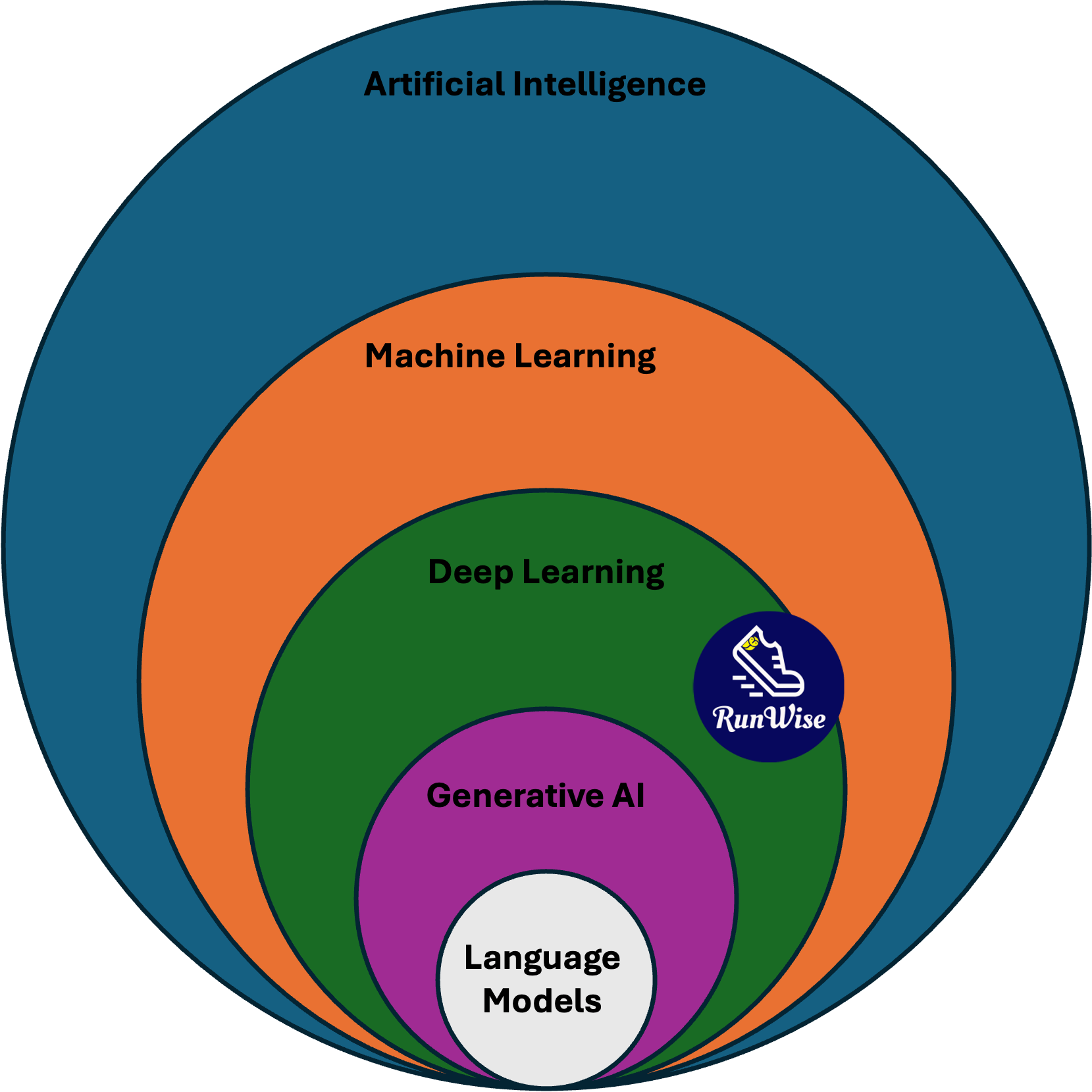
When you hear that the RunWise injury predictor platform is powered by AI, it might be comfortable to picture something familiar: a chatbot generating advice and maybe eventually replacing the coach. But that’s not what is happening. To understand why, it helps to understand what a language model does at its core. Despite the conversational surface, a language model is fundamentally a pattern-matching machine trained on an enormous corpus of text. It has processed vast amounts of human language and learned, statistically, which words tend to belong together. When you prompt the language model, it draws on the patterns learned during training to produce a response.
Artificial neural networks, the architecture behind both language models and RunWise, were inspired by the human brain. Just as neurons fire and strengthen connections through repeated signals, an artificial neural network learns by adjusting internal connections based on training examples. Feed it enough data and it gets better at recognizing the patterns that matter.
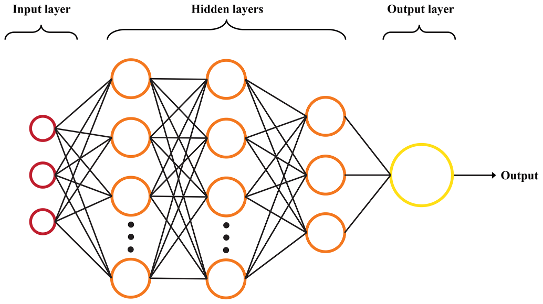
The RunWise model is an artificial neural network trained not on words but on running data. In particular, the model was trained using features derived from biomechanical load data such as volume, intensity, and consistency, each measured across periods of different length. During the training process, the model analyzed examples of what training looked like before overuse injuries occurred and what it looked like when runners stayed healthy. As a result, it learned patterns that tend to separate the two.
Thus, RunWise can’t respond to prompts like a language model. It doesn’t produce text, advice, or training plans. RunWise calculates features from running data, processes the features with the trained model, and produces a single probabilistic output: LOW, MEDIUM, or HIGH.
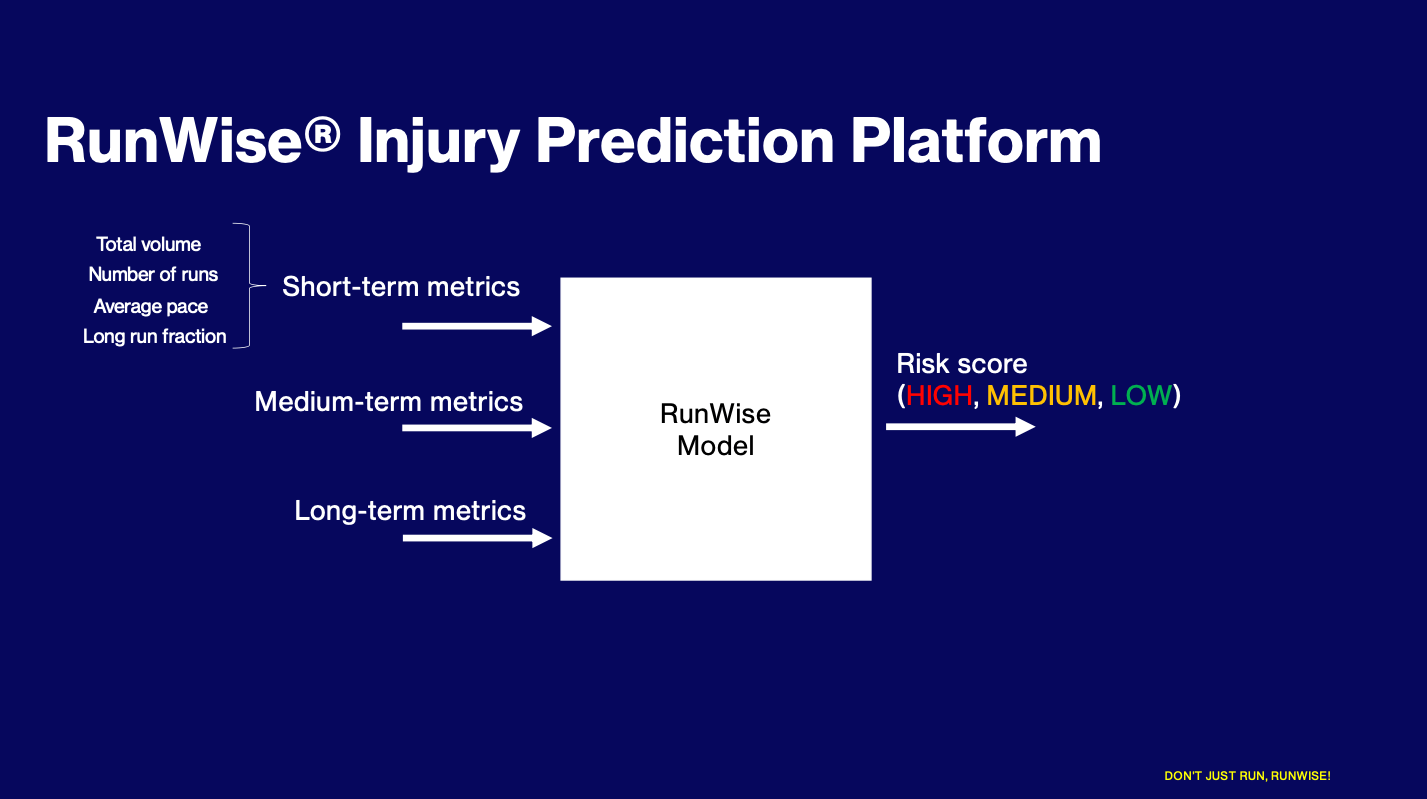
That contrast is worth sitting with. A language model is predicting which words belong together. RunWise is predicting whether a runner’s current training patterns resemble ones that preceded injuries. While both are doing statistical pattern recognition, the patterns could not be more different.
Anxieties surrounding AI are oftentimes anxieties about what generative tools do, for example producing content, inserting themselves into creative and professional work, and possibly replacing human expertise. RunWise isn’t doing any of these things.
The race director’s reply is a reasonable response to a complicated landscape. But a binary choice, AI in or AI out, carries a cost. Bundling every application of the technology into a single verdict means that the tools worth scrutinizing and the tools worth using get swept out together. The better questions for assessing an AI tool are more specific: what is this particular tool doing, and does it do that well?2
RunWise is powered by a probabilistic machine trained to recognize injury risk patterns for runners. Its model is trained on running data to do one specific thing. Analyze running data and tell the runner how the conditions look, similar to a weather forecast. Most importantly, RunWise doesn’t tell the runner what to do. It provides information so the runner can make better decisions about training. For runners, that means more consistency and fewer interruptions.
At its core, RunWise exists for one reason: to help runners keep doing what they love, for as long as possible. If that’s what AI can look like, it’s worth understanding.
According to the AI Summary in response to a Google search on June 5, 2026.
Of course, use of the AI tool should align with your values. In other words, after answering these questions, you may decide against use for certain tasks. For example, a college student might decide to not use AI to write a paper even if the AI can skillfully complete the task.