The Old Rules, Revisited
Why the 10% Rule Still Gets Runners Hurt


By some estimates, more than 50% of runners are injured annually. Think about that: one out of two, every year. Despite decades of research and coaching wisdom, we still don’t fully understand who gets injured and why.
RunWise AI was founded to address that problem. We don’t see machine learning as a silver bullet, but we believe it can be part of the solution. For example, injury predictions can be used in combination with other data to help runners stay healthy and maintain consistency in training.
Below are summaries of traditional injury preventions solutions. If these solutions were acceptable, then runners wouldn’t still be suffering injury at such a high rate.
Listening to Your Body
“Listen to your body” is the oldest advice in running. Long before wearables, our bodies were the only feedback loop we had. Tightness, fatigue, and pain are all signals from a system trying to stay in balance.
The challenge is that runners often tune those signals out. We tell ourselves the soreness is normal, the fatigue is just a phase, the ache will fade after a few miles. Listening sounds easy, but it takes practice and honesty to tell the difference between adaptation and warning. And because listening is reactive, not predictive, the signal often arrives too late.
10% Rule
The 10% rule is a well-known guideline in running. Don’t increase weekly mileage by more than 10% week-to-week. For example, if you ran 30 miles this week, you shouldn’t run more than 33 miles next week. As a rule of thumb, it is meant to prevent injuries that happen as a result of ramping up training too quickly. Easy enough, right? Not in practice.
The 10% rule emerged over time through experience. Coaches noticed that runners who made big jumps in volume sometimes got hurt, while those that built up more gradually stayed healthy. Hence 10% became a heuristic guide for increasing volume.
While useful, the 10% rule oversimplifies a complex problem. First of all, there is no individual variability. Some runners can handle larger volume increases than others. Additionally, the rule treats all volume as equal. Ten percent more easy running is not the same as ten percent more speed work. Moreover, the rule ignores cumulative fatigue and recovery. Small increases may lead to injury when the runner’s baseline is too high and/or the runner requires additional rest and recovery.
Acute-to-Chronic Workload Ratio (ACWR)
ACWR was once the darling of sports science. It compares recent training load, e.g. the past week, to a longer-term average, e.g. the last four weeks. The theory was simple: if short-term load (the “acute” part) spiked too far above baseline (the “chronic” part), injury risk climbed.
Coaches like ACWR because it feels scientific and provides a single number to track. Typically, a ratio around 1.0 is considered “safe,” while anything above 1.5 is seen as “risky.”
In practice, though, injuries are messy and individual. ACWR does not capture factors like fatigue, sleep, stress, terrain, weather, or intensity. Recent research in the British Journal of Sports Medicine questions its predictive value entirely.*
RunWise Solution
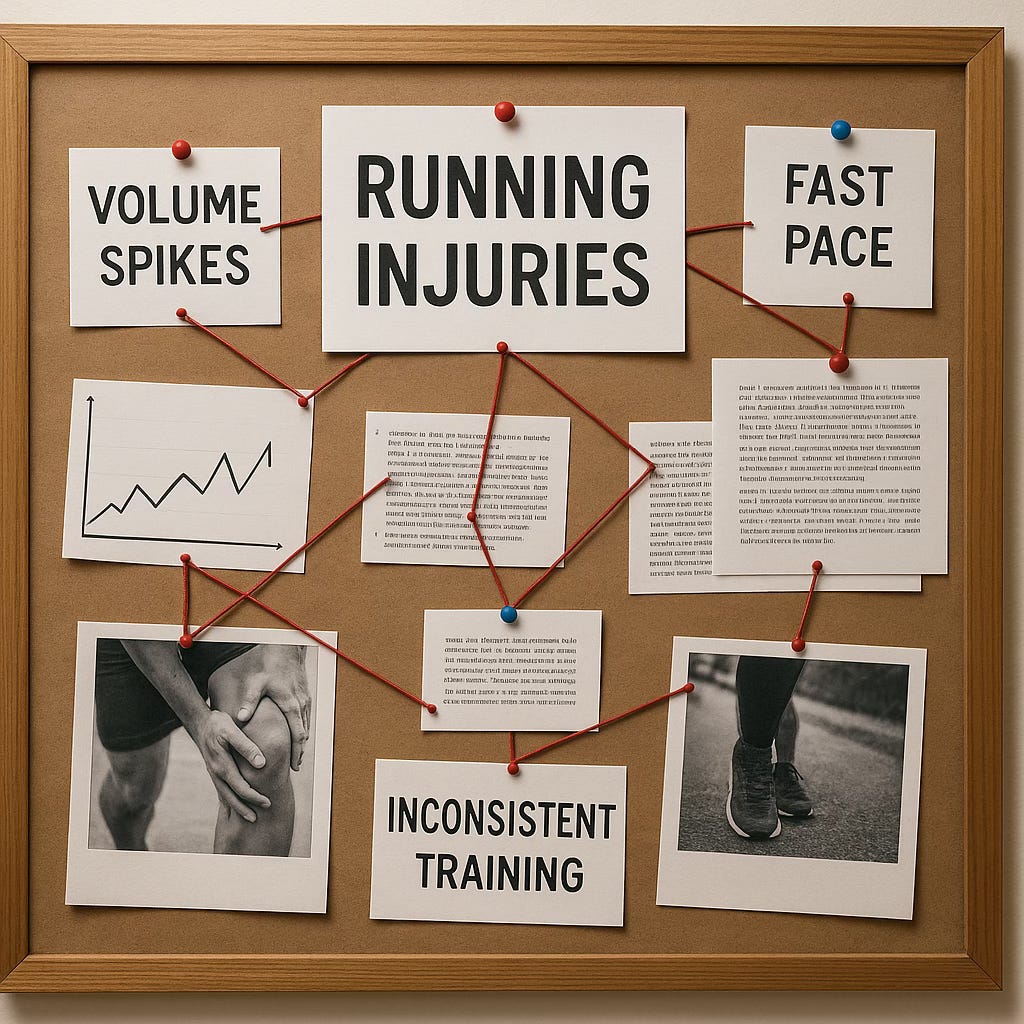
Think of RunWise AI as a skilled detective built for the complexity of running injuries. Unlike “listening to your body,” it is data-driven, and unlike the 10% rule or ACWR, it does not focus on volume alone. RunWise analyzes the interactions between reliable load metrics such as volume, intensity, and consistency.
Trained on a labeled data set, the model has learned subtle patterns that link training behavior to injury outcomes. These patterns may include spikes in mileage, clusters of fast runs, inconsistent training, and combinations thereof. When a runner connects, RunWise evaluates recent running data and compares it with what it has learned from the labeled data set.
It’s not magic; it’s pattern recognition designed for the real world, where training stress never acts in isolation. The RunWise model helps runners understand how the pieces fit together, because injuries rarely stem from a single cause.
* Windt, J., et al. “The acute:chronic workload ratio has lost its utility as an injury prediction tool,” British Journal of Sports Medicine, July 2025, https://bjsm.bmj.com/content/early/2025/07/07/bjsports-2024-109380.