The Michigan
A Cross Country Runner’s Worst Nightmare, Trusted Friend, or Both?

The Michigan was the brainchild of Coach Ron Warhurst. Simple but brutal. 1600 m, 1200 m, 800 m, 400 m with 2000 m tempo “recovery.” The reps are run on the track, and the tempos are run around the University of Michigan’s football stadium.

Michigan Stadium By Lectrician2 - Own work, CC BY-SA 4.0, https://commons.wikimedia.org/w/index.php?curid=110611578
We ran a variation of The Michigan each fall at the Naval Academy. Our coach, Al Cantello, adapted it to our campus where the tempo “recovery” consisted of loops around Dewey Field. My experience with The Michigan was back in the late nineties and early aughts, well before workouts were shared online. Apparently though, this workout had spread around the country. Maybe coaches shared insights at meets or conferences. Or possibly ex-Michigan athletes joined the coaching ranks and passed it to the next generation.
Regardless, The Michigan made its way to the Naval Academy. The workout totaled about 7 miles and lasted more than 35 minutes, so I had to stay locked in for a long time. The reps on the track were hard, each one progressively faster than the last, and I couldn’t overexert if I wanted to finish strong. Plus, the tempo wasn’t really recovery. Backing off the pace a bit made for a prolonged, uncomfortable grind. The Michigan was a suffer-fest but completing it was immensely satisfying. It felt like a litmus test for fitness, nurturing a strength and confidence in me that bordered on invincibility.
I don’t remember asking Coach Cantello why we did The Michigan (or any other prescribed training for that matter). He was intimidating, so my strategy was to fly under the radar and let running do the talking.
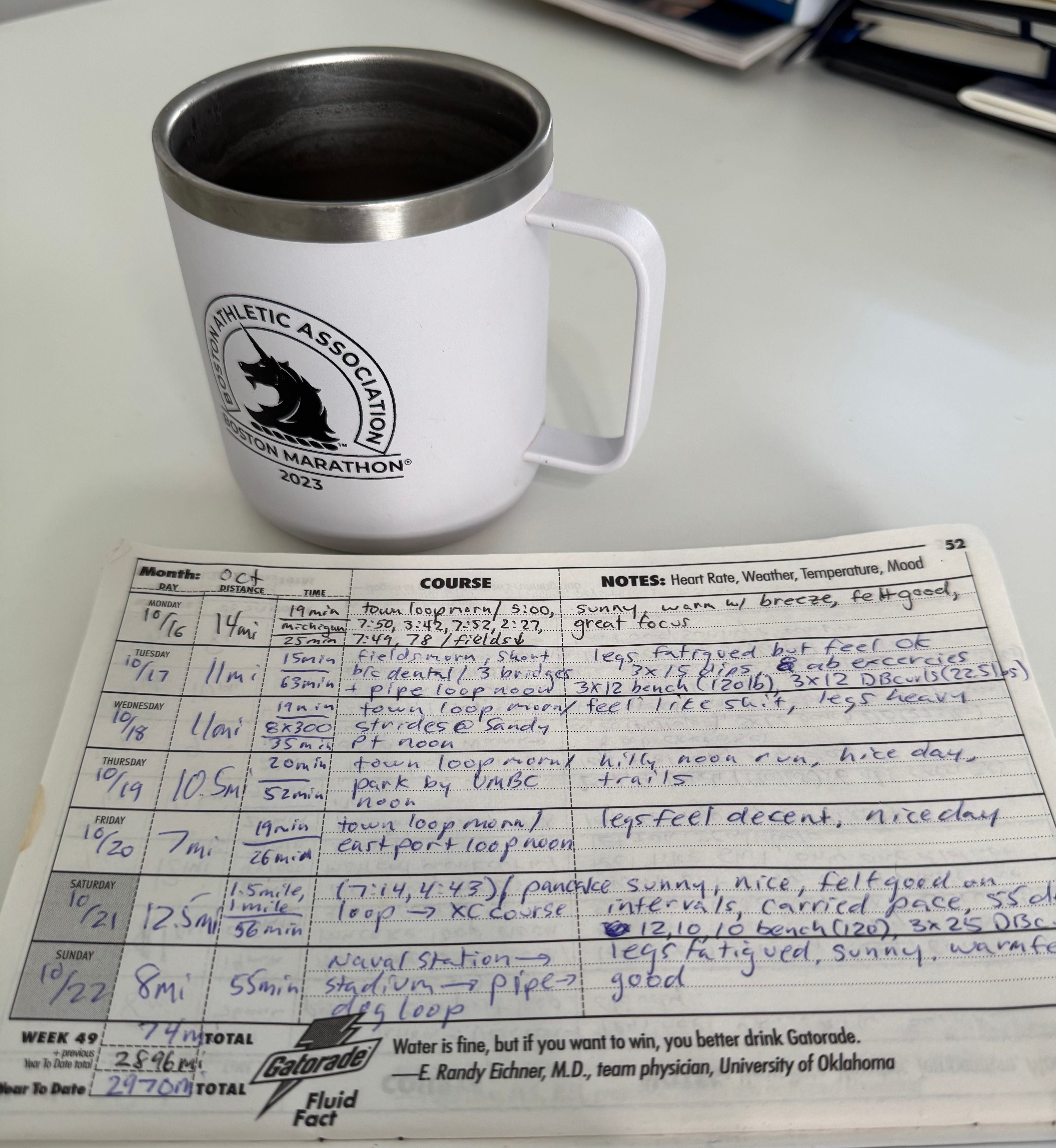
More than 25 years later, I still find occasional references to The Michigan, and each one makes me feel nostalgic. A recent email campaign highlighting “big workouts” and featuring The Michigan led me straight to the garage where I dug my college running logs from storage. I wanted to glimpse into the past and confirm my recollection.
The Michigan, as I now understand, was designed to prepare runners for cross country racing. While most competitive running is an individual endeavor, cross country is first and foremost a team sport. Each team’s score is the sum of its first five runners’ places in the race, and the lowest score wins. Cross country meets take place offroad on all sorts of terrain: grassy fields, wooded trails, up and down hills, and in all sorts of conditions: heat, freezing cold, rain, sleet, snow. As a result, a runner’s placement is more important than finish time.
Team, terrain, and weather set the conditions for a unique event. Fast starts, numerous mid-race surges, and “leave it all out there” finishes. For sure there is time to settle into the race, but each runner needs to execute the team’s plan and respond to what the competition throws at him. It’s not about individual performances. It’s about the team. One place can make the difference between success and failure.
I sat there reading these old logs, reminiscing about my college runs. The journals reveal good days and shitty days, runs both mundane and noteworthy, and running locales familiar and forgotten. The notes from October 16, 2000 state: “sunny, warm w/ breeze, felt good, great focus.” Are these scribbles all that’s left of the last time I completed The Michigan at Navy?
Running has been a throughline in my life, shaping who I am in ways I can easily see. What I didn’t expect was how much wisdom hides inside the smaller parts of the whole. Zoom in on one, like a workout, and you find another layer of teaching waiting there.
By running The Michigan, I was conditioning both body and mind to respond to uncertainty during a stressful event. A premeditated start from the sound of the gun. Getting control of my nerves, settling in for the long haul, and staying intensely focused on the task at hand. Surging when necessary. Carefully metering my effort so as to not run out of gas too soon. Taking that next step with confidence when, quite frankly, it’d be easier to step off the track and quit. And ultimately sprinting to the finish line.
While I won’t be running The Michigan this fall, its lessons feel equally relevant to my current challenge of building a startup company. In this sense, The Michigan lives on.
Love this. While training and science evolve, there are still plenty of lessons we can learn from the past.